
Impartial Conflict Resolution
The Concord Foundation’s engagement in impartial conflict resolution — anywhere in the world — focuses on intractable violent political conflict between groups with disturbed historic relationships using the three lenses of Politics, Psychology and Faith.
POLITICS
How A Community Understands And Organises Itself
PSYCHOLOGY
How People In All Their Complexity Engage With Themselves And Other
FAITH
How People Understand And Engage With Their Culture And Beliefs
Recent Updates
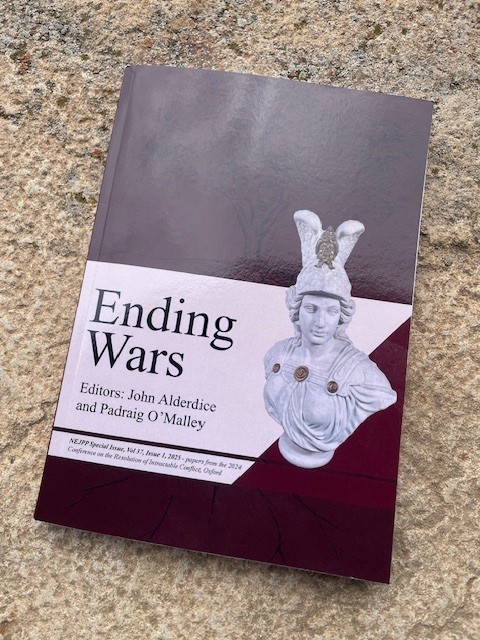
New book on ‘Ending Wars’ just published
There has not been a time in many decades when a book about Ending Wars was more timely. People across the world are rightly terrified that the rules-based international order that brought a degree of peace to much of the world, is rapidly dissolving and we are descending into international antagonism, with a mixture of authoritarian governments and failing states – the result being unending war and chaos. This new multi-author volume, co-published by The Concord Foundation and ARTIS (Europe) Ltd, in collaboration with the New England Journal of Public Policy, addresses these existential dangers.
Why do we have wars? They arise because human beings have differing and often conflicting interests and desires, even within themselves, and certainly between themselves and others. When some human beings decide to impose their will on others and the victims resist, there is a conflict. If the former group is prepared to use physical violence and the latter group in turn resists with force, the fight may escalate, causing sufficient casualties, and lasting long enough to qualify as a ‘war’. Throughout history this is how most groups conducted their relationships with each other.
Until 1945 the limits of our capacity to destroy our enemies and wreak havoc on our environment, ensured that after a violent conflict, while damage was done and many people perished, the world and humanity could restore themselves. Since the development of the nuclear bomb there can be no such reassurance. For a time, the limited number of nuclear states and the realization by their leaders of the existential consequences of a nuclear war ensured a degree of restraint mediated through vicarious conflicts and the development of global political institutions and international law.
Today we watch with mounting fear as we see those restraints dissolving. At the same time human activity has increasingly impacted the adaptive systems of the natural world and damaged their capacity for repair. So, we are faced with the prospect of both nuclear holocaust and environmental catastrophe and only modest evidence of humanity taking either threat sufficiently seriously. We are living through the most dangerous time in the history of humanity. What is to be done?
This newly published multi-author volume addresses the challenge of ‘Ending Wars’ and is the companion volume to ‘The Changing Character of War and Peacemaking’ which we published last year. Together they make a significant contribution to our understanding of the challenges of war and peace, but they also chart possible ways of addressing them.
They are both available on Amazon as paperbacks and e-books.
The Changing Character of War and Peacemaking (paperback)
The Changing Character of War and Peacemaking (e-book)
They are also available from ARTIS (Europe) Ltd
Lord Alderdice’s Twitter / X Feed

During his visit to #Azerbaijan, UK Trade Envoy @AlderdiceLord got acquainted with the state-of-the-art #Boeing 787-9 Full Flight Simulator (FFS) developed by @acronaviation at National Aviation Academy's training centre in #Baku @FCDOGovUk @biztradegovuk @ukinazerbaijan

RT @ElinSuleymanov: Good to see 🇬🇧 UK Trade Envoy @AlderdiceLord visiting Nakhchivan, a vital part of regional connectivity initiatives and…
Lord Alderdice welcomed today’s announcement by the Charity Commission for NI that it has launched a statutory inquiry into the PCI and all its component elements. “I have been pressing for an enquiry because PCI must live up to its responsibilities as a charity and as a church.”